Managing projects
Creating a Project
To create a new project:
-
Open the Project List page and click Create new project.
-
The Project creation window opens.
-
Select the project type that meets your needs and click it.
-
Define project details:
- Project name
- Assignee
- Due date
- Assets scope (for the Issue resolution, Asset onboarding and Baseline rule rollout projects, it can be Entire Organization (all assets) or Limited Scope (selected assets or asset labels); for other project types, only the Limited Scope (selected labels/assets) is available)
-
For some types of projects, additional parameters are required:
- Issue resolution: You will be able to select issues to be resolved. This step can be omitted and done any time later.
- Asset onboarding: A goal for the number of assets to be onboarded must be defined.
- Asset health hardening: A health score target must be defined.
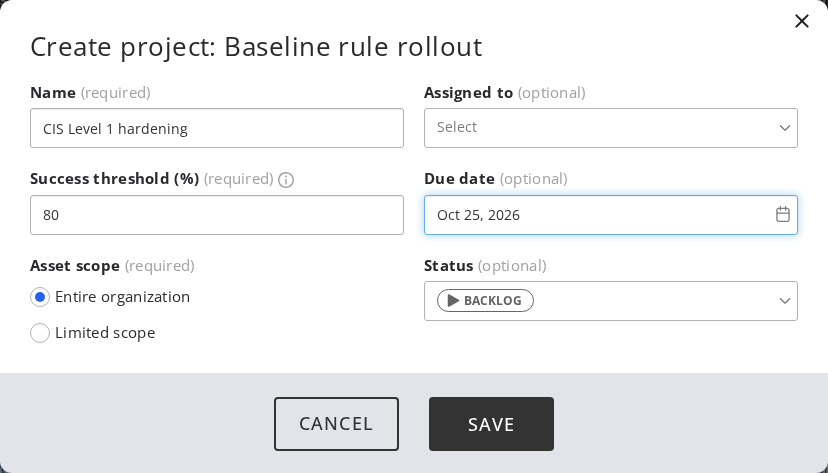
- Baseline rule rollout: A success threshold must be defined. You will be able to select the benchmark rules to roll out. This step can be omitted and done any time later.
-
Once all details are defined, click Create and the project is created.
Baseline rule rollout projects
A Baseline rule rollout project helps you adopt benchmark rules that are not yet in your baseline. Rules that are not in the baseline do not create issues, so you can work towards them gradually and promote them to the baseline once enough of your assets pass them.
Creating a rollout project and changing its rules requires the Manage projects permission. Promoting rules to the baseline additionally requires the Manage benchmarks permission, and users whose access is limited to labels cannot promote rules. If such a user has the Manage benchmarks permission, the completion window still selects the option to add rules to the baseline by default, and completing the project fails until they clear it.
Project settings
- Success threshold (%): The percentage of assets that must pass a rule for the rule to count as adopted. The value must be between 50 and 100, and the default is 80. All rules in the project share the same threshold.
- Due date: Optional, as for all other project types. The Project Details page shows it as End date, with the number of days left next to it.
- Asset scope: Select Entire organization to measure all assets in the organization, or Limited scope to measure only selected assets or asset labels. A rollout project only counts assets that belong to the organization where it was created; assets in suborganizations are not included.
Adding rules to a rollout project
You can add rules when you create the project, or at any time later while the project is not completed or archived. Only automated benchmark rules that are not in the baseline can be added.
There are four ways to add rules:
- Select rules on the Benchmark rules page and click Add to Rule Rollout Project. See Security configurations.
- In the project creation window, choose Baseline rule rollout, fill in the project details and select the rules in the next step. Click I'll do it later to create the project without rules.
- On the Project List page, click the Plus sign in the Rules column of the project, select the rules, and click Confirm.
- On the Project Details page, click Assign rules, select the rules, and click Confirm.
To remove the selected rules from a project, clear that project in the Add to Rule Rollout Project dialog and click Confirm.
How progress is calculated
For each rule, Nanitor calculates the pass rate: the percentage of assets in scope that pass the rule. A rule counts as met when its pass rate is equal to or higher than the success threshold. The project progress is the number of met rules divided by the total number of rules in the project. The calculation uses benchmark results that Nanitor has already collected, so no additional data collection is needed.
Only assets that the rule applies to are counted, that is, assets that are assigned to the benchmark profile the rule belongs to. A Windows rule is therefore not measured against Linux assets. An assigned asset that has no result for the rule yet counts as not passing. A rule with no assets to measure counts as not met. Archived assets are not counted.
Unlicensed assets are not counted. Network-discovered assets are not counted when network discovery is turned off for the organization.
Rule exclusions (issue filters) are not taken into account. An excluded asset that fails the rule still counts as not passing.
Rule pass rates are recalculated whenever you open the project. Overall progress is refreshed every few minutes. The figures keep updating after the project is completed.
The pass rate of each rule is shown on the Rules tab of the Project Details page. The Assets tab lists the assets that at least one rule of the project applies to. An asset is done when all rules that apply to it pass.
Completing a rollout project
You can complete a rollout project before all rules have reached the threshold. On the Project List page, click Complete in the action menu of the project, or Mark as completed in the Progress column when all rules have been met. The project must be in progress to be completed.
The completion window lists how many rules reached the threshold and how many did not. If you have the Manage benchmarks permission and at least one rule that reached the threshold is not yet in the baseline, the window shows the option Add N rules that reached the threshold to the baseline. The option is selected by default. When you click Mark completed, those rules are added to the baseline. Clear the option to complete the project without changing the baseline. The rules that did not reach the threshold stay linked to the project and are not promoted.
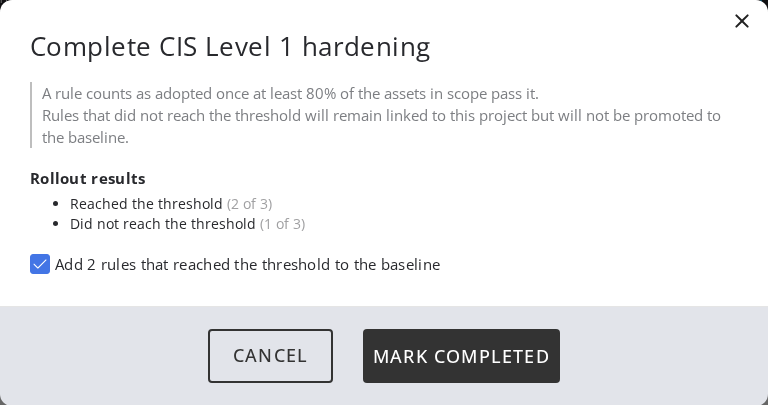
Each promoted rule is added to the baseline of the benchmark profile it was rolled out from and is recorded in the Activity Log as a Baseline rule saved entry.
If adding the rules to the baseline fails for any benchmark profile, the project is not completed and stays open, and an error message is shown. Rules that were already added stay in the baseline. You can retry, and rules that are already in the baseline are ignored.
The following ways of completing a rollout project skip the completion window described above, so no rules are promoted:
- Setting the project status to Done from the status menu or the Kanban board.
- The Congratulations! window. The Project List opens it automatically when you open the list and a project has reached 100% progress, and it also opens from Mark as completed in the page's action menu. Its Mark completed button completes all selected projects without promoting any rules. To promote rules, click Maybe later or remove the rollout project from the selection, and then complete the project with Complete in its action menu or Mark as completed in its Progress column.
Promoted rules create issues
Once a rule is in the baseline, assets that fail the rule create issues. If the organization uses its parent organization's baseline, promoting rules changes the parent's baseline, so it affects the parent and every suborganization that uses it. If suborganizations use this organization's baseline, the promoted rules are added to their baseline as well, so failing assets in those suborganizations also create issues.
Editing a Project
To edit a project:
- Do one of the following:
- On the Project List page, click Edit project in the Action column for the selected project.
- On the Project Details page, click Edit project.
- In the Edit project window, edit project details.
NOTE: issues cannot be assigned via project editing. To add issues to an existing Issue resolution project, visit the Issue List and add the desired issues to the project from there.
Adding Assets to the Scope
For unfinished asset-based (i.e. not Issue resolution) projects with limited scope, assets can be assigned to the project at any time. Assets can be assigned either via project editing or directly on the Project List page. To add assets on the Project List page:
- Navigate to the Affected Assets column for the selected project and click the Plus sign there.
- The Assign assets window opens. It contains the list of assets that can be assigned to the project.
- Select the assets to be assigned and then click Confirm.
Assigning Issues to the Project
Issues can be assigned to Issue Resolution projects from the Issues List as well as from any Issues Inventory lists. Issues can also be assigned to the projects directly on the Project List page. To assign issues to the project on the Project List page:
- Navigate to the Issues column for the selected project and click the Plus sign there.
- The Assign issues window opens. It contains the list of issues that can be assigned to the project.
- Select the issues to be assigned and then click Confirm.